
Introduction
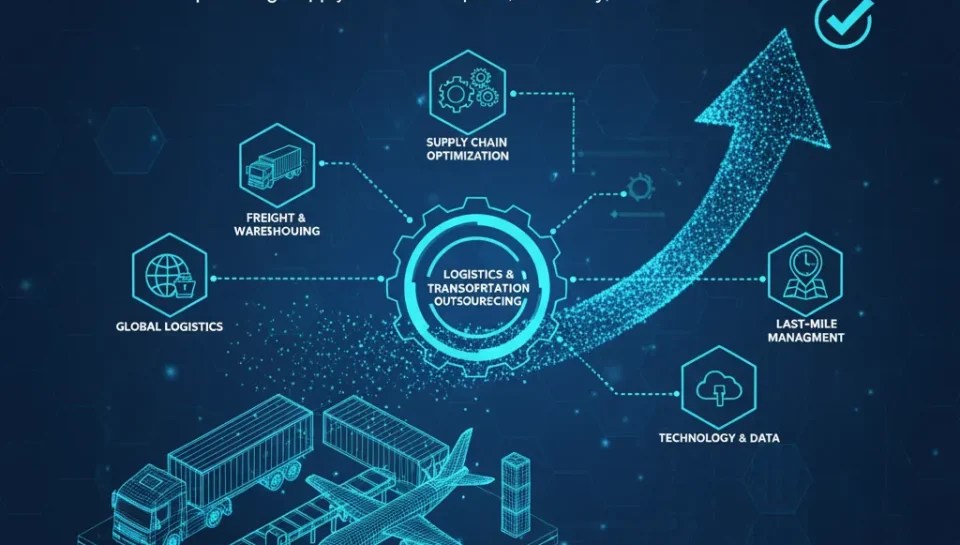
The logistics and transportation industry powers global commerce — connecting manufacturers, suppliers, and customers through complex, high-volume networks.
However, rising costs, evolving regulations, and sustainability expectations are redefining how logistics providers operate.
To stay competitive, organizations are embracing logistics outsourcing and transportation outsourcing models that combine automation, analytics, and digital transformation.
From supply chain automation and freight audit outsourcing to ESG in transportation, outsourcing helps enterprises achieve real-time visibility, operational agility, and environmental responsibility across the logistics value chain.
1. The Growing Role of Outsourcing in Logistics and Transportation
Modern logistics operations are data-driven and time-sensitive, demanding precision and adaptability.
Outsourcing key functions — such as finance, IT, HR, and customer service — allows logistics providers to focus on their core expertise: delivering seamless, on-time transport and supply chain excellence.
Why the Sector is Embracing Outsourcing:
- To enhance real-time visibility through supply chain automation and IoT integration.
- To optimize routes and reduce fuel consumption with AI analytics.
- To streamline finance, HR, and compliance functions.
- To implement ESG in transportation through digital sustainability reporting.
- To provide superior customer experience with faster, automated support channels.
By adopting shared services and digital outsourcing frameworks, logistics companies are achieving measurable gains in cost control, delivery accuracy, and sustainability.
2. Supply Chain and Operations Automation
In logistics, speed and precision are non-negotiable.
Supply chain automation combines AI, RPA, and predictive analytics to reduce manual intervention, improve forecasting, and enable proactive decision-making.
Automation Capabilities:
- Route Optimization: AI algorithms analyze traffic, weather, and delivery constraints to reduce transit time and fuel costs.
- Real-Time Tracking: IoT-enabled devices provide visibility across fleets, warehouses, and last-mile deliveries.
- Inventory & Warehouse Management: Automation in scanning, picking, and packaging ensures accuracy.
- Demand Forecasting: Predictive analytics align production and distribution with demand cycles.
- Exception Management: Automated alerts for delays, shortages, or quality issues improve responsiveness.
Example:
A global freight company implemented supply chain automation, improving on-time delivery by 30% and reducing logistics costs through predictive route planning.
3. Finance & Freight Audit Outsourcing
Managing freight invoices, audits, and multi-currency transactions can be time-consuming and error-prone.
Freight audit outsourcing and finance shared services help logistics companies maintain cost accuracy, improve payment cycles, and ensure financial transparency.
Finance Outsourcing Services:
- Freight Audit & Payment: Validation of carrier invoices, tariffs, and contract terms.
- Accounts Payable & Receivable: RPA-driven invoice processing and collections management.
- Budgeting & Forecasting: AI analytics for route profitability and cost optimization.
- Regulatory Reporting: Compliance with customs, taxation, and trade documentation.
- Financial Dashboards: Real-time expense tracking for logistics networks.
Example:
A leading transportation firm adopted freight audit outsourcing, achieving 99% billing accuracy and reducing invoice processing time by 50%.
4. IT Outsourcing and Digital Transformation in Logistics
As logistics networks become digital ecosystems, logistics IT support plays a crucial role in ensuring integration, cybersecurity, and performance.
Outsourced IT services enable logistics providers to modernize platforms, manage infrastructure, and deliver seamless digital customer experiences.
IT Outsourcing Capabilities:
- Cloud Infrastructure Management: Hosting and monitoring of logistics ERP, WMS, and TMS systems.
- Cybersecurity & Data Privacy: 24×7 protection of shipment and payment data across global operations.
- IoT & Sensor Integration: Real-time tracking of goods, vehicles, and storage conditions.
- AI-Powered Analytics: Performance dashboards for delivery accuracy and route efficiency.
- RPA in IT Operations: Automating ticket management, maintenance logs, and data migration.
Example:
A logistics operator outsourced IT infrastructure and IoT management, reducing downtime by 40% and achieving real-time monitoring for over 1,000 global shipments daily.
5. HR Outsourcing and Workforce Management
With distributed workforces across hubs, ports, and distribution centers, logistics companies require agile HR systems.
HR outsourcing ensures consistent employee management, payroll accuracy, and regulatory compliance across geographies.
HR Outsourcing Services:
- Recruitment Process Outsourcing (RPO): Specialized hiring for drivers, warehouse staff, and supply chain professionals.
- Payroll & Compliance Automation: Multi-country payroll aligned with labor laws and safety regulations.
- Training & Safety Programs: Continuous skill-building on digital tools and workplace safety.
- Performance Management: Dashboards to track workforce productivity and engagement.
- Diversity & Inclusion Analytics: ESG-aligned workforce metrics and reporting.
Example:
A global logistics provider outsourced HR operations, achieving 90% automation in payroll and reducing compliance issues across 12 international locations.
6. Customer Service Outsourcing for Logistics Providers
Customer expectations for visibility and responsiveness are at an all-time high.
Customer service outsourcing equips logistics companies with multi-channel support and AI-based engagement tools that ensure real-time updates and faster resolutions.
Customer Support Services:
- AI Chatbots: Automated responses for shipment tracking, delivery queries, and payment updates.
- Omnichannel Support: Unified dashboards integrating email, voice, chat, and social media.
- SLA-Based Resolution Management: Measurable turnaround times and escalations.
- Customer Feedback Analytics: NLP tools analyze satisfaction and service trends.
- Proactive Notifications: Automated alerts for delivery status and potential delays.
Example:
A freight forwarding firm implemented AI-led customer service outsourcing, improving resolution speed by 40% and achieving 25% higher customer satisfaction scores.
7. ESG and Sustainability in Transportation
The logistics sector is at the heart of the global sustainability movement.
ESG in transportation outsourcing enables organizations to track carbon emissions, promote ethical practices, and report environmental impact transparently.
ESG Outsourcing Capabilities:
- Carbon Emission Monitoring: IoT and AI measure fuel consumption, route efficiency, and CO₂ footprint.
- Sustainable Fleet Management: Data-driven decisions for electric or low-emission vehicles.
- Social Responsibility Programs: Tracking safety, workforce diversity, and community engagement.
- Governance & Transparency: ESG dashboards for supplier audits and ethical sourcing.
- Sustainability Reporting: Automation aligned with GRI, SASB, and BRSR frameworks.
Example:
A transportation conglomerate adopted ESG outsourcing, reducing emissions by 18% through optimized route planning and automated sustainability reporting.
8. Benefits of Logistics & Transportation Outsourcing
| Function | Key Benefits |
|---|---|
| Supply Chain Automation | Improved visibility, real-time tracking, and route efficiency. |
| Finance & Freight Audit | Accurate billing, lower costs, and faster payment cycles. |
| IT & Infrastructure | Reliable, secure, and scalable logistics systems. |
| HR & Workforce | Efficient, compliant, and performance-driven operations. |
| Customer Support | Enhanced responsiveness and higher satisfaction scores. |
| ESG & Sustainability | Transparent environmental and ethical impact tracking. |
Outcome:
Organizations leveraging outsourcing in logistics achieve up to 40% process efficiency, 99% billing accuracy, and measurable gains in sustainability and customer satisfaction.
Conclusion
The future of logistics lies in intelligence, integration, and innovation.
Through logistics outsourcing and transportation outsourcing, enterprises can streamline operations, enhance compliance, and enable supply chain automation powered by AI and analytics.
From freight audit outsourcing and logistics IT support to ESG in transportation, outsourcing transforms logistics providers into connected, data-driven ecosystems that deliver faster, greener, and more reliable global transportation solutions.

